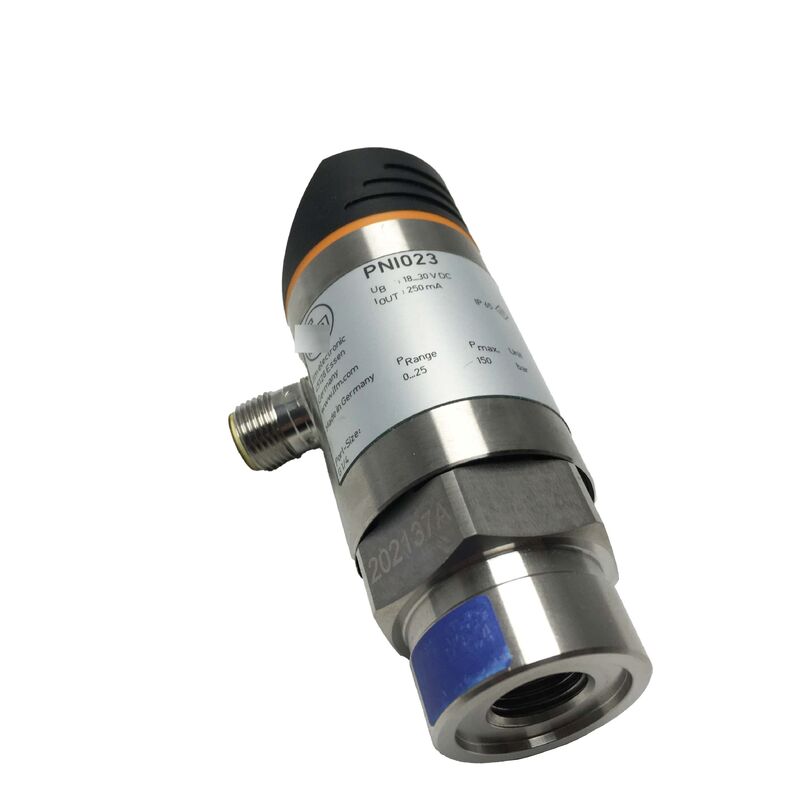
The ifm PNI025 is a pressure sensor with integrated analog input—a specialized member of ifm's PN sensor family that builds set/actual comparison logic directly into the sensor head. This compact device performs differential pressure monitoring by comparing its internal pressure measurement with an external analog signal from a second pressure transmitter or process signal source.
The sensor continuously computes the difference between these values and triggers switching outputs when thresholds are crossed, eliminating the need for external signal conditioning electronics and separate comparators.
| Parameter | Value |
|---|---|
| Full Ordering Code | PNI025-RBR14-QFRKG/US/V |
| Related Variant | PNI023 |
| Analog Input | External voltage or current signal |
| Process Connection | G 1/4 internal thread |
| Switching Outputs | 2 × programmable (PNP/NPN) |
| Display | 4-digit alphanumeric LED |
| Operating Voltage | 18-30V DC |
| Operating Temperature | −25 to +80°C |
| Protection | IP 65 |
| Connector | M12 |
| Key Application | Differential pressure monitoring |
The analog input accepts signals from external transmitters—typically 4-20mA current loop or 0-10V voltage outputs from secondary pressure sensors. The PNI025 continuously compares this external signal against its own measured pressure value with fast update rates suitable for dynamic hydraulic and pneumatic applications.
Switch points are configured using pushbuttons and the 4-digit LED display, which shows real-time differential values for precise setup and troubleshooting. The automatic adjustment function allows normalization to current operating conditions, establishing a baseline for tracking deviations.
The PNI025 is ideal for hydraulic filter condition monitoring. As filters accumulate contamination, differential pressure increases. The sensor detects this change and triggers outputs at configured thresholds without requiring PLC programming.
Applications include:
The 4-digit alphanumeric LED display provides clear visibility across machine bays and can be rotated 180° for flexible mounting. Three buttons enable straightforward programming of switching thresholds, hysteresis, and output logic polarity without complex software.